
Introduction
Worldwide, abandoned settlements stand as melancholy
reminders of once thriving communities that have long since vanished. These
“ghost towns” provide a fascinating insight into the physical, social, economic
and environmental forces that shape human settlements. While countries such as
the US, partly because of their sheer size, are home to hundreds of ghost
towns, there are relatively few in the UK.
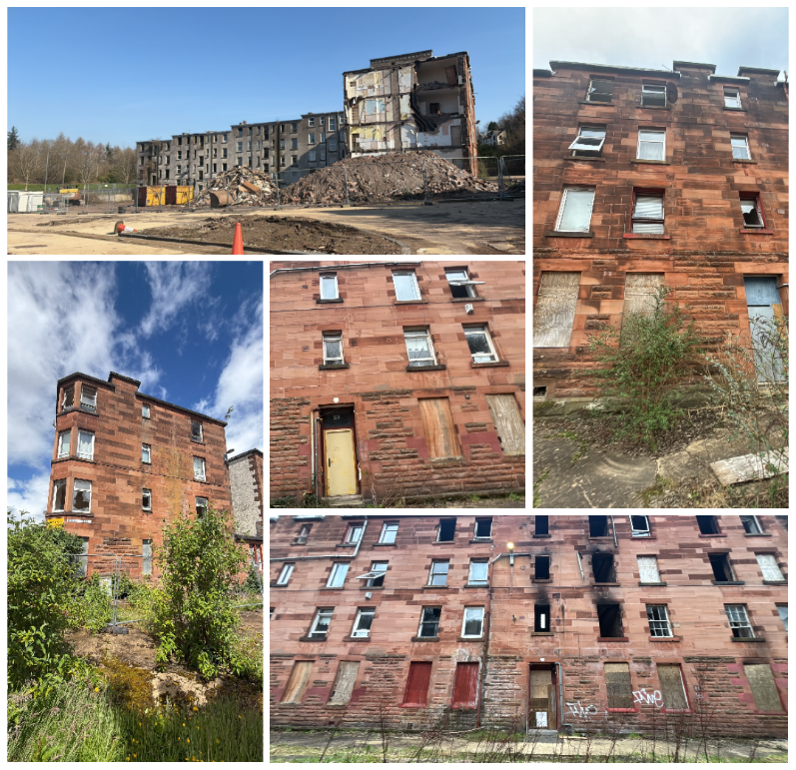
Clune Park in Port Glasgow is a striking example of an
abandoned urban neighbourhood. Once home to hundreds of shipbuilding workers
and their families, the estate has become synonymous with urban decay. Many of
its buildings stand empty and derelict, creating the impression of a place
frozen in time.
This article explores the story of Clune Park and examines
the reasons why this once thriving neighbourhood became too dangerous for
habitation. It looks at its rise and fall, and finally asks whether this
remarkable piece of history is capable of salvation.
What is a Ghost Town?
A ghost town is a settlement that has been entirely or
largely abandoned by its residents. Ghost towns can emerge for a variety of
reasons, including: natural disasters, depletion of resources, government
relocation schemes, and economic collapse.
Some places fail because, like Clune Park, they have been
built around one industry. When that industry disappears, employment
opportunities vanish and residents have no choice but to relocate elsewhere.
No-one moves into the area to occupy the buildings they have left behind them,
and one by one, these former homes fall into a state of dereliction. Over time,
the entire settlement is abandoned.
Clune Park is a distinctive example of a modern urban ghost
town, with abandonment occurring gradually over a number of decades rather than
as a result of a single catastrophic event.
The Birth of Clune Park
Clune Park’s origins are intertwined with the growth of
shipbuilding on the banks of the River Clyde. During the nineteenth and early
twentieth centuries, more than 30,000 ships were constructed there,
establishing Scotland as a global leader in maritime engineering.
To accommodate rapidly growing workforces employed in the
shipyards, housing developments were built close to major industrial sites.
Clune Park was established in the early twentieth century by the Lithgow
shipbuilding family to house the workers employed in Port Glasgow's shipyards.
The estate comprised approximately 430 flats arranged across
45 tenement blocks, whose red sandstone construction was a distinguishing
feature alongside their flat, concrete roofs. It was designed to provide
everything the workers required, including a school, a church and local
amenities. At its peak, Clune Park was home to thousands of residents and
reflected the prosperity of an industry that would provide employment for
generations of local families.
Today, it’s easy to forget that, for decades, the Clune Park
estate was a vibrant and bustling place, where workers and their families lived
and socialised, and built their hopes and dreams around the success of the
Clyde’s shipyards.
The Slow Decline
Clune Park’s decline mirrored the widespread collapse of
Britain's heavy industries during the second half of the twentieth century.
From the 1960s onwards, Britain’s shipbuilding industry was
facing increasing competition from countries such as Japan and South Korea.
These countries operated more efficiently and at lower costs, making it
difficult for firms on the River Clyde to compete. Labour disputes, changing
technologies and declining investment levels further weakened the industry. In
1975 the Lithgows took the decision to sell the estate to multiple landlords
and diversify their interests away from the shipbuilding industry.
As the shipyards were forced to lay off their workers, or
were closed down altogether, employment opportunities in Port Glasgow dwindled.
Younger people left in search of job opportunities elsewhere, and others
relocated to newer housing developments. Clune Park’s population continued to
fall and vacancies became commonplace.
Rather than experiencing a sudden collapse, Clune Park
entered into a prolonged and painful period of decline. Each departing resident
reduced the demand for local services, making the location even less attractive
to those who remained. Over time, the estate became trapped in a cycle of
depopulation and deterioration.
When a Community Disappears
A proliferation of empty buildings is one of the clearest
indicators of a disappearing community. As populations fall, the institutions
that once supported them tend to disappear as well.
At Clune Park, falling occupancy rates eventually
contributed to the closure of key local facilities. The church that had served
generations of residents closed in 1997, while the primary school ceased
operating in 2008. Their closure reflected the gradual breakdown of the
community that had existed there for almost a century.
Property values also collapsed. As demand for housing fell,
prices plummeted, with some flats reportedly being sold at auction for as
little as £7,000. As more properties were vacated, incidents of vandalism,
neglect and anti-social behaviour became commonplace. Crime and social problems
became increasingly prevalent. The estate's physical decline reinforced its
negative reputation, leading to further population loss and spiralling decline.
Who was Responsible?
Critics will often point the blame at absentee landlords,
given that they own properties but don’t live nearby or actively manage them.
At Clune Park, fragmented ownership also made it difficult to regenerate the
area. As the buildings deteriorated, often the owners lacked the incentive or
the means to invest in maintaining them.
At the same time, legal wrangling between property owners
and Inverclyde Council significantly delayed redevelopment efforts. It has cost
the Council £3 million just to secure the dangerous buildings on the estate and
pursue legal cases through the courts. Yet legal challenges have slowed
progress and repeatedly delayed efforts to regenerate the area. In 2016, an
attempt to demolish the estate proved unsuccessful, while later efforts to
impose levies on the vacant properties also faced legal challenges.
Ultimately, the decline of Clune Park was the consequence of
multiple interacting factors: economic change, fragmented ownership, absentee
landlords, population decline, legal challenges, and long-term neglect.
Life inside Scotland's Urban Ghost Town
The Clune Park of today presents a striking contrast to its
former self.
Many of the buildings on the estate have fallen below modern
housing standards and are mere shells. The landscape is dominated by empty
windows, boarded-up entrances and crumbling facades and its post-apocalyptic
appearance has led to the area being dubbed “Scotland’s Chernobyl”.
Crime, vandalism and arson have worsened the situation. For
example, the former primary school (a significant listed building) has suffered
fire damage.
Despite these challenges, Clune Park stands out as an
important reminder of the social consequences of industrial decline and shows
how economic restructuring can reshape entire communities and leave lasting
scars on an urban landscape.
Can Clune Park be Saved?
So, can Clune Park still be saved? For years, debates about
its future have raged. The final consensus has been that many of the buildings
had deteriorated beyond the possibility of economically viable repair, and
therefore demolition was the only feasible solution. The extent of the
buildings’ structural problems made large-scale restoration impractical.
As part of a wider regeneration strategy for the area, plans
were approved to clear much of the estate and replace it with new housing. The
£31 million redevelopment programme aims to deliver approximately 135 new homes
over two phases. Although the former church and school were both listed
buildings and therefore historically significant, they will be demolished as
part of the regeneration works.
Supporters argue that the redevelopment will deliver safer,
higher-quality housing that will help to attract new residents to the area.
Critics lament the imminent loss of an important part of Port Glasgow's
heritage.
Conclusion
Clune Park’s story is ultimately one of transformation.
Built to support one of Britain’s most lucrative industries, it gradually
evolved into one of the country's most striking examples of urban decline.
This decline was not the result of one single event but of
decades of deindustrialisation, population loss, absentee landlords and delayed
interventions. As jobs disappeared, residents left, buildings fell into
disrepair, and its most important institutions were closed down. The result:
the emergence of a modern ghost town at the heart of Port Glasgow.
Yet, while the original estate may have disappeared, the lessons learned from it are still highly relevant. Clune Park is a powerful reminder of the way in which communities can be shaped and destroyed by economic forces, and of how difficult decisions must sometimes be made when planning for the future. It’s important that we don’t repeat the same mistakes, to prevent the emergence of any other ghost towns in the future.