
When neighbourhoods decline due to economic shifts, aging
infrastructure, or population changes, they can lose their value, vibrancy and
sense of identity. Urban renewal is the process of bringing these areas back to
life, physically, socially, economically and culturally. For forward thinking
property platforms like Land Hero, understanding urban revival is key to
recognising where transformation opportunity and long-term value.
Urban revival refers to the rejuvenation of declining urban
areas. Unlike traditional redevelopment approaches that focus mainly on
demolishing and rebuilding, urban revival takes a holistic path. It’s closely
related to urban renewal and community revitalisation but differs slightly.
Urban renewal has historically focused on large scale physical redevelopment,
often via top-down planning, whereas community revitalisation concentrates on
strengthening social networks, encouraging participation an improving local
service.
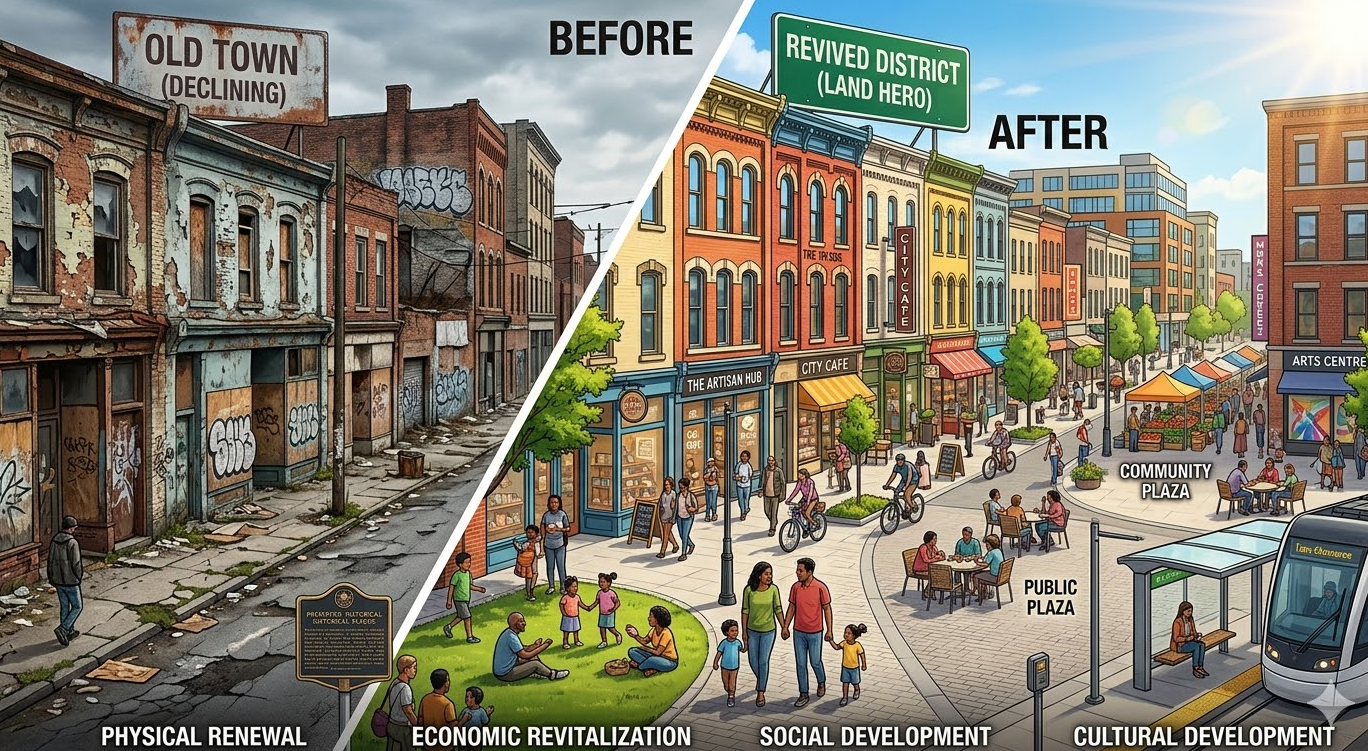
Urban revival integrates both approaches, combining physical improvements with economic development strategies and community engagement, ensuring that regeneration benefits both the area and its residents.
Physical Renewal
This involves improving the built environment to increase
functionality and attractiveness. The common measures for this include
renovating existing buildings, upgrading housing and infrastructure, enhancing
public spaces and improving transport networks and accessibility.
These improvements make urban areas more liveable and suitable for residential and commercial uses.
Economic Revitalisation
Sustainable revival requires economic stability and growth.
Strategies may include attracting new businesses and investment, supporting
small and medium sized enterprises, encouraging mixed use development and
creating employment opportunities.
Economic revitalisation strengthens the local tax base and supports long term area stability.
Social and Community Development
Urban revival emphasises inclusive development by engaging
local communities in planning processes, improving access to local services and
supporting affordable housing initiatives.
The aim is to reduce displacement risks and ensure that improvements benefit existing residents.
Cultural Development
Cultural assets often play a strategic role in regeneration.
This may involve preserving historic buildings and heritage sites, supporting
arts and creative industries and developing cultural districts or public
programming.
Cultural incentives can reinforce local identity and
increase an areas attractiveness to residents and visitors.
Purpose and Impact
The primary goal or urban revival is to transform declining
areas into stable, functional and economically active urban environments. When
implemented effectively it can increase property values, encourage private and
public investment, improve living standards and promote sustainable, long-term
growth.
Modern urban revival strategies increasingly focus on
balanced development that avoids displacement-driven redevelopment and
prioritizes inclusive growth.
Why Urban Revival is relevant…
For property stakeholders, developers and urban planners,
urban revival signals potential growth and strategic investment opportunities.
Areas undergoing revival often experience infrastructure upgrades, increased
demand and improved economic activity.
Understanding urban revival provides insight into how urban
areas evolve and where sustainable development opportunities may emerge.
In summary, urban revival is a comprehensive regeneration
approach that combines physical improvement, economic stimulation, community
engagement and cultural development to create stable and sustainable urban
environments.